Negombo, Sri Lanka – 10 June 2026
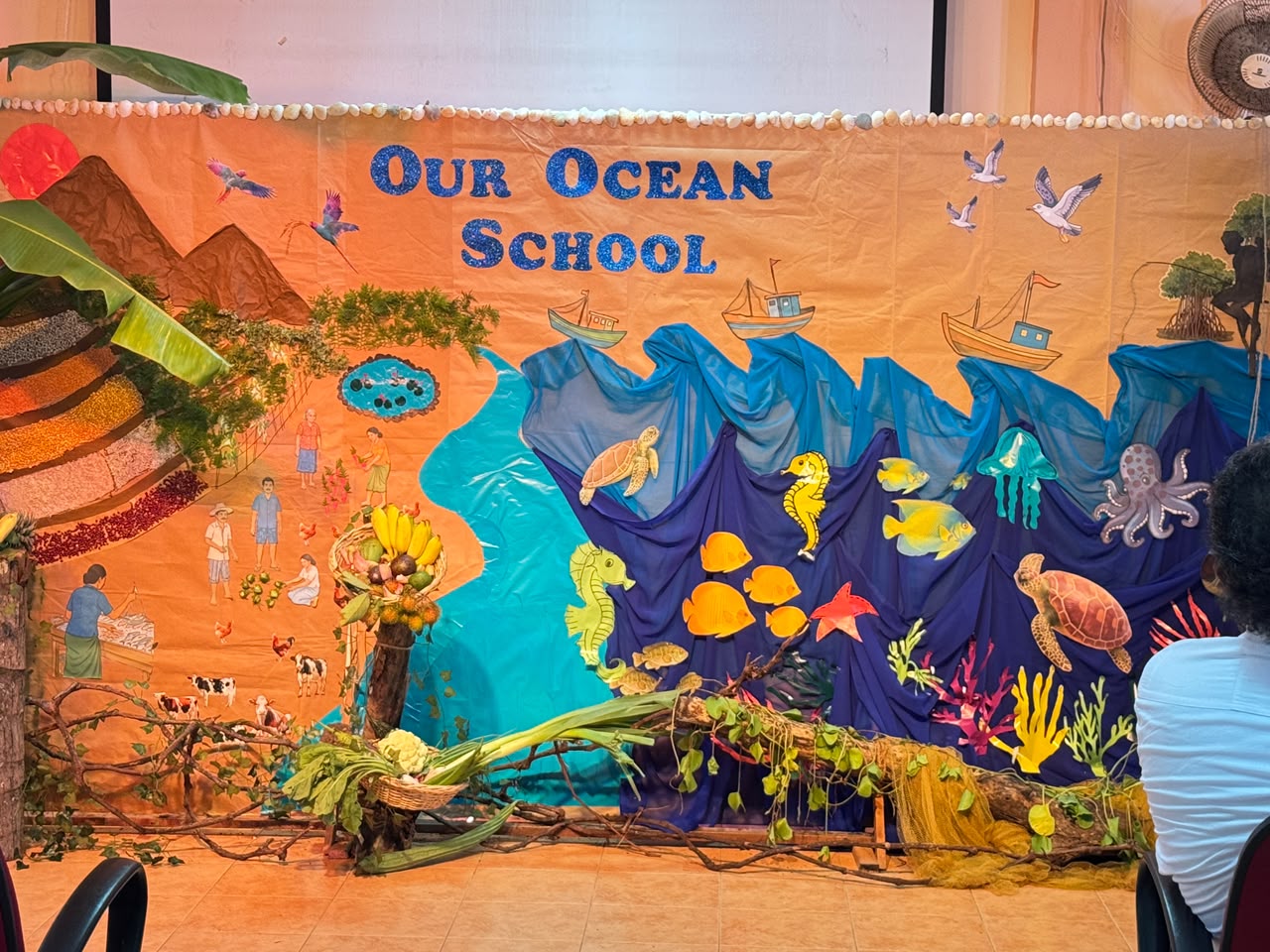
On 8 June 2026, World Oceans Day, the “National Fisheries Solidarity Organization (NAFSO)” of Sri Lanka successfully inaugurated its pioneering “Our Ocean School” programme at its premises in Negombo. The hybrid event — held in person and streamed live via Zoom — drew a large gathering of renowned guests, community leaders, youth, women fishers, civil society representatives, academics, and international partners from the “World Forum of Fisher Peoples (WFFP)” network.
The inauguration marked the official launch of a transformative educational initiative designed to strengthen community stewardship of oceans and coastal resources while building the next generation of leaders in the small-scale fisheries movement.
A Vision Rooted in Justice, Sustainability and Collective Action
“Our Ocean School” emerges as the key vehicle for NAFSO’s ongoing work in social and environmental transformation. It integrates “Aqua-Ecology” principles with traditional ecological knowledge, community-led management, and nature-based solutions to address the fisheries crisis. The programme places special emphasis on youth leadership, gender equity, equitable resource sharing, and the active participation of coastal, lagoon, and inland fishing communities.
In the days leading up to the event, NAFSO highlighted core thematic principles and values of Aqua – ecology concept:
- Focuses on food for people.
- Values food providers.
- Localizes food systems
- Puts locals in control
- Building on knowledge and skills
- Working with nature
These principles guided the vision shared during the inauguration: healthy ecosystems and empowered communities go hand in hand; lasting ocean, lagoon and inland aqua system conservation is only possible when local communities play a central role in protecting, managing, and sustaining the resources they depend on.
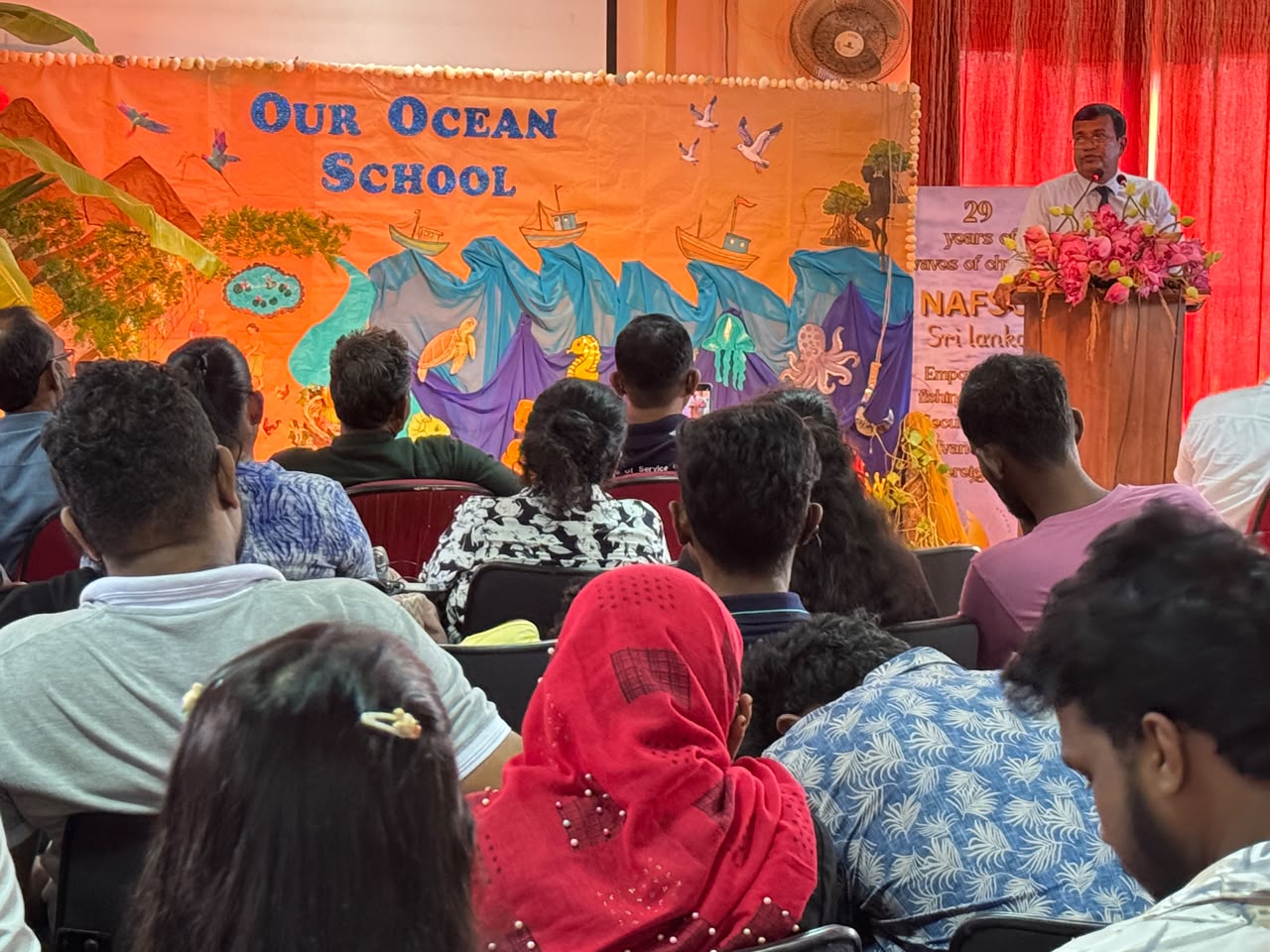
Deputy minister of environment making a statement
Strong Collaboration with WFFP
The launch carries special significance for the global WFFP family. NAFSO and WFFP are jointly initiating an international training programme on Aqua Ecology, introducing a new dimension to the future of fisheries grounded in the principles adopted by both organisations.
As part of the same effort, Practical programmes will roll out in three distinct contexts:
- Coastal fisheries in Galle
- Lagoon fisheries in Gampaha ( Negombo )
- Inland fisheries in Polonnaruwa
This multi-site approach ensures the Ocean school reaches diverse fishing communities across Sri Lanka while serving as a replicable model for WFFP members worldwide.
Renowned Guests and Inspiring Participation
The inauguration ceremony was enriched by the participation of many renowned guests who brought decades of experience from the fisheries sector, academia, civil society, and the international fisher people’s movement. Their presence underscored the broad support for community-driven approaches to ocean governance and sustainable livelihoods.
Research officer of WFFP Madara Wijethunge delivered the welcome address and presented the objectives of the Our Ocean School programme. Her remarks highlighted the urgent need to equip youth and women with knowledge, leadership skills, and opportunities for meaningful participation so they can become changemakers today — not just leaders of tomorrow.
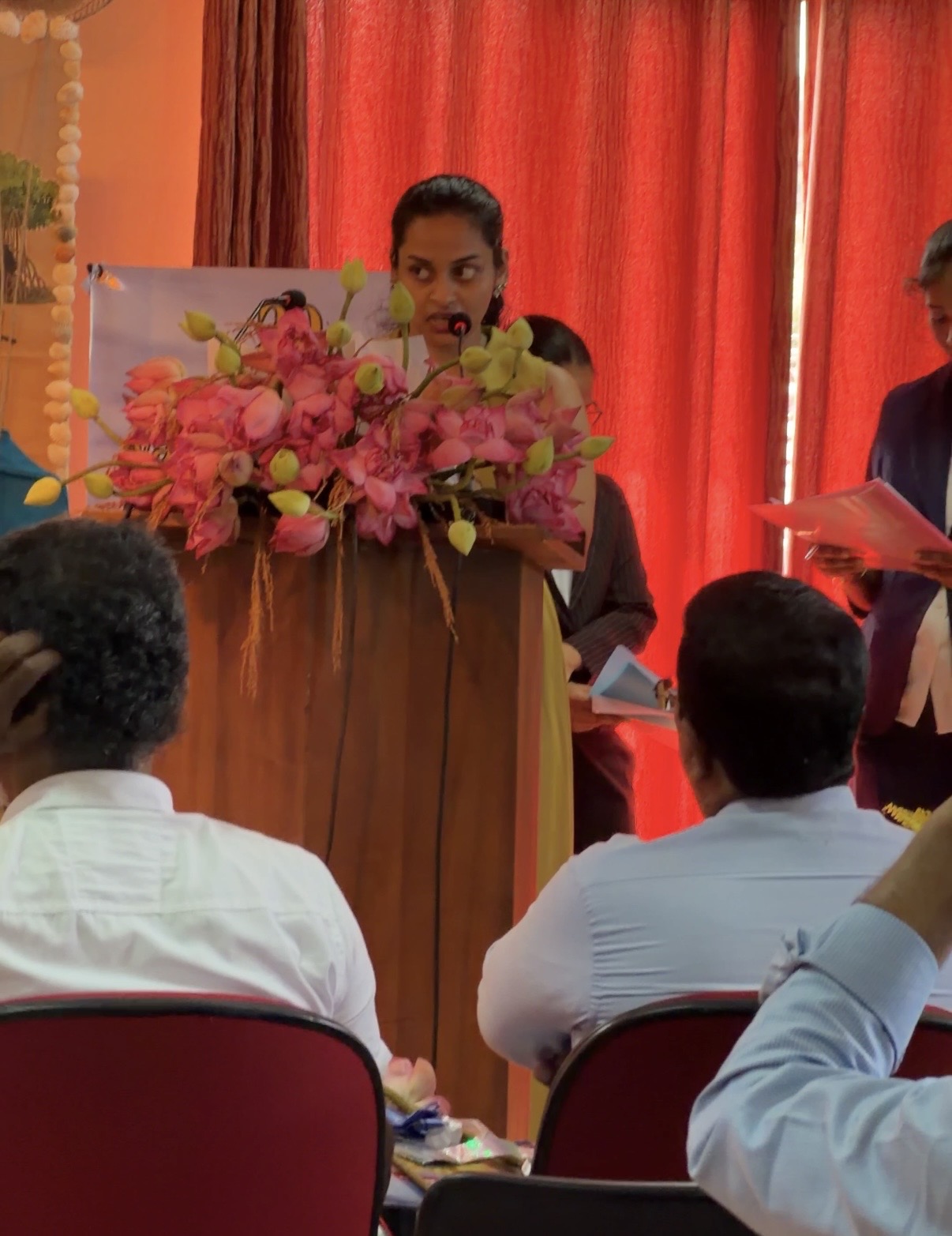
WFFP research officer Madara wijethunga making some remarks
Then the deputy minister of environment took the stage and spoke on behalf of the government and expressed strong support for community-led approaches to ocean and coastal resource management. He acknowledged the vital role played by organisations like NAFSO in protecting marine ecosystems while securing sustainable livelihoods for fishing communities. The Minister stressed that national environmental policies must be implemented in close partnership with fishing communities and civil society, and praised the Our Ocean School initiative as a timely and practical model that aligns with the government’s vision for a resilient and sustainable blue economy.
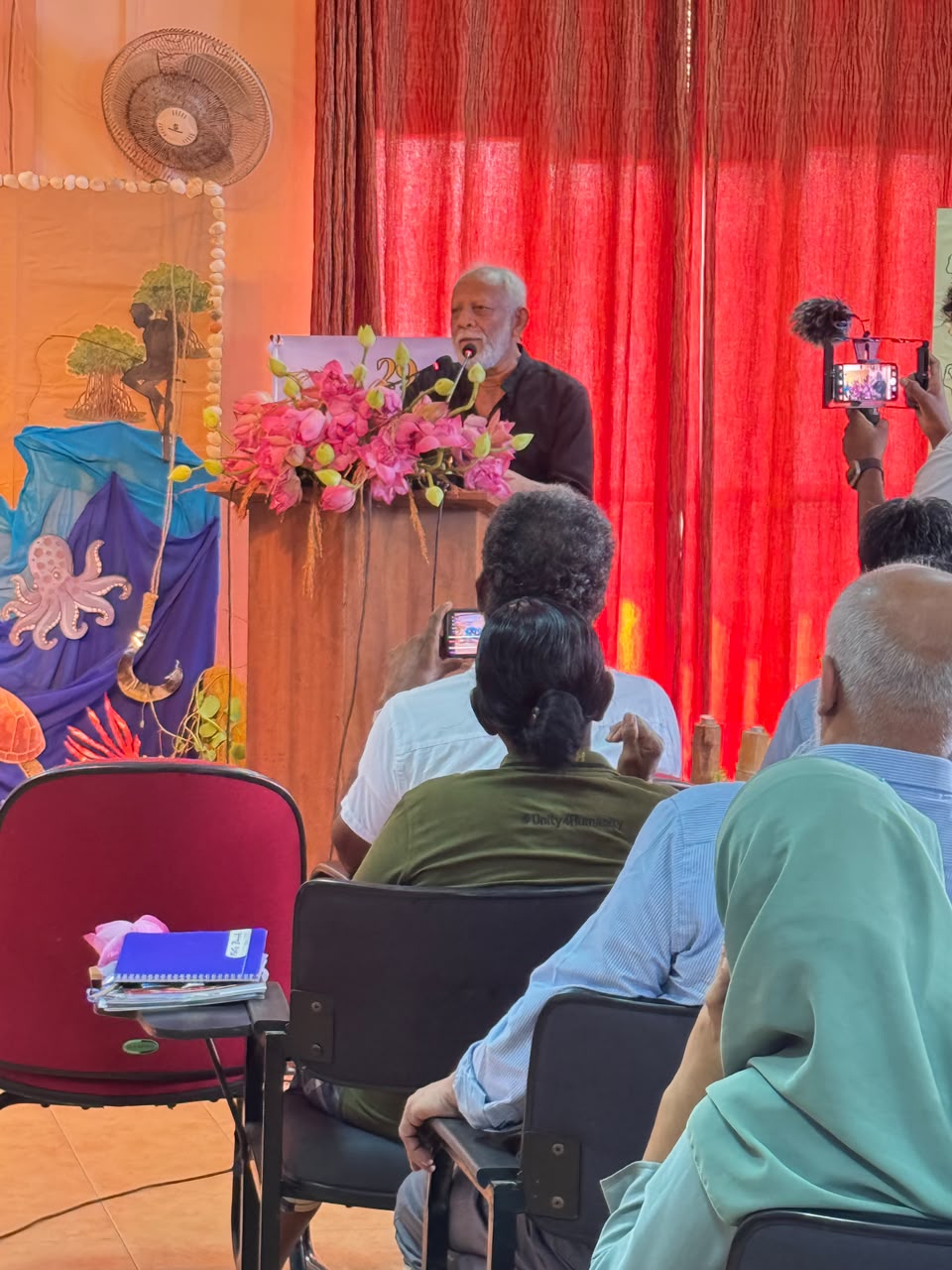
Prof Oscar Amarasinghe chancellor of Ocean university sri lanka delivering a speech
Later Prof Oscar Amarasinghe, Chancellor of Ocean University of Sri Lanka, underscored the critical importance of bridging academic institutions with grassroots fishing communities. He emphasised that universities must move beyond traditional classrooms and actively support community-based education initiatives such as Our Ocean School. He highlighted the need of providing technical knowledge, research support, and capacity-building opportunities for youth and women in coastal areas, noting that the future of Sri Lanka’s oceans depends on creating a new generation of ocean-literate leaders who combine scientific understanding with traditional ecological knowledge.
Prof G M Kularathne expressed his happiness of launching this particular initiative saying he’s waited so long to witness this moment and delivered a thought-provoking address focusing on the scientific and ecological foundations of the programme. He elaborated on the principles of Aqua Ecology and how community-based stewardship, combined with nature-based solutions, can address the growing challenges of climate change, habitat degradation, and declining fish stocks. Prof Kularathne encouraged participants to view Our Ocean School not only as an educational platform but also as a living laboratory where traditional knowledge and modern science work together to restore and protect marine and coastal ecosystems.
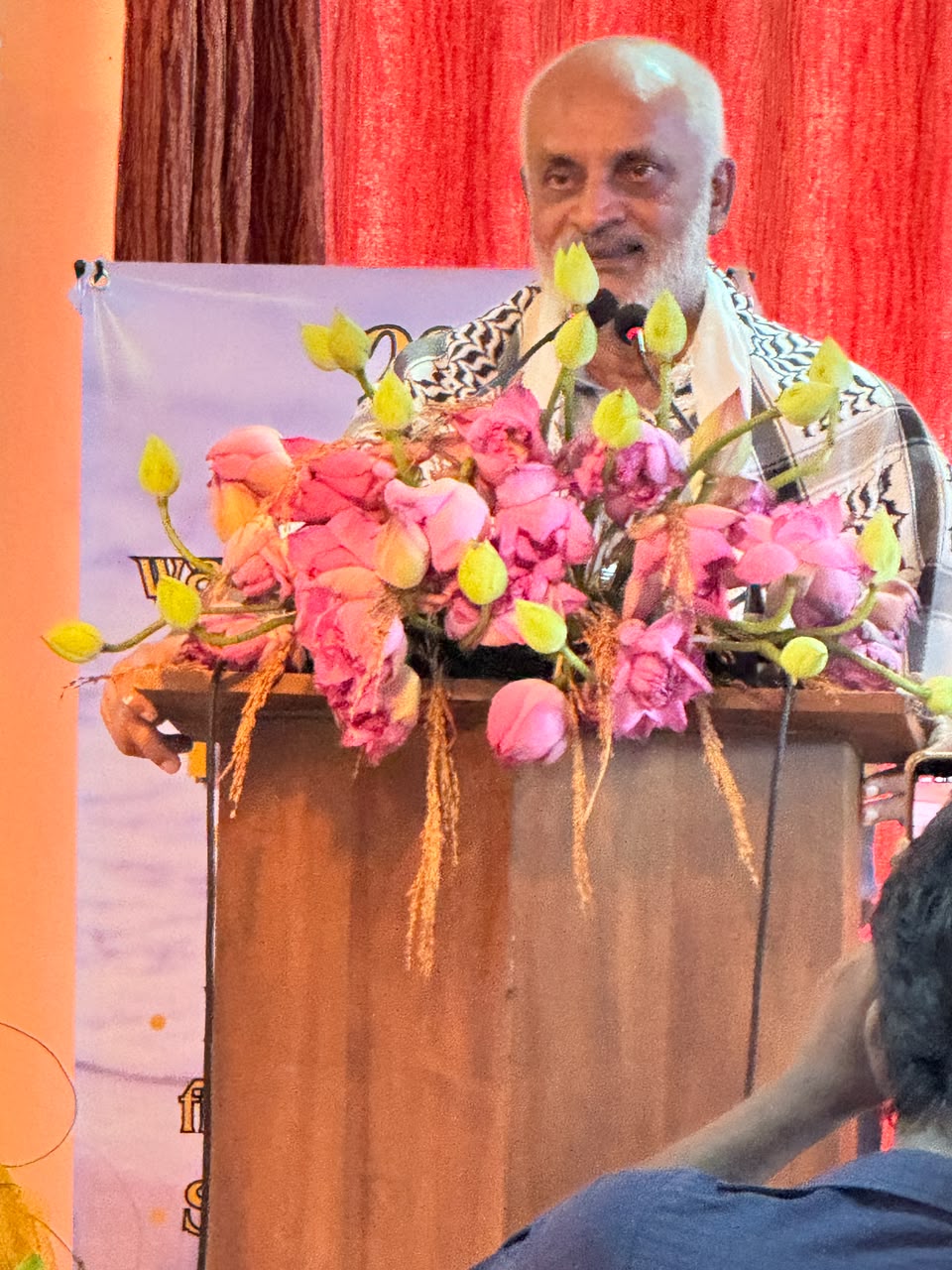
Mr Herman Kumara ( General secretary of WFFP ) addressing the crowd
Mr Herman Kumara, General Secretary of the World Forum of Fisher Peoples (WFFP) and National Convener of NAFSO, shared the broader vision behind the launch of Our Ocean School. He described the programme as a significant milestone in the global struggle of small-scale fishing communities for ocean justice and food sovereignty. Mr Kumara explained how “Our Ocean School” will serve as the vehicle to roll out practical Aqua-Ecology training across Galle, Negombo, and Polonnaruwa. He called upon all participants — youth, women, community leaders, academics, and government representatives — to work together in building a strong movement that defends the rights of fisher peoples and ensures that the benefits of the ocean are shared equitably. He concluded by expressing gratitude to all partners and reaffirming NAFSO and WFFP’s commitment to transforming the vision of Our Ocean School into concrete action on the ground.
The speeches collectively reinforced the collaboration between academia, government, and people’s movements, setting a powerful and hopeful tone for the journey ahead of the “Our Ocean School programme”. Participants left the event energised, with many expressing strong commitment to the journey ahead.
A Resounding Success on World Oceans Day
The successful holding of the inauguration on World Oceans Day 2026 reinforced NAFSO’s and WFFP’s shared commitment to ocean justice, community resilience, and sustainable coastal development. By centring the wisdom, leadership, and collective power of fishing communities, the Our Ocean School offers a powerful counter-narrative to top-down conservation models that often marginalise the very people who have stewarded the seas for generations.
Official launching of Aqua-ecology.com website
During the event , NAFSO and WFFP also marked the official launch of the dedicated Aqua-Ecology website. This new digital platform will serve as a global resource hub, providing training materials, pilot project updates from the coastal, lagoon and inland sites, researches, and collaborative tools to advance community-led sustainable fisheries and ocean stewardship. The launch of the website alongside “Our Ocean School” underscores the shared commitment to making “Aqua-Ecology” principles accessible, practical and scalable for fishing communities, researchers , scholars and students worldwide.
Looking Ahead
In the coming months and years, “Our Ocean School” will roll out training, political education, and practical Aqua-Ecology initiatives across Sri Lanka and beyond. The programme aims to strengthen food sovereignty, defend the rights of small-scale fishers, promote gender justice, and contribute to the global struggle for equitable and sustainable ocean governance.
WFFP warmly welcomes this initiative and looks forward to close collaboration as “Our Ocean School” grows into an international learning platform for fisher peoples everywhere.
Together, we protect ecosystems. Empower communities. Sustain our future.
For more information about “Our Ocean School” or to explore partnership opportunities visit “Aqua-ecology.com”