COFI:FM Sub Committee, Reykjavik, Iceland 2026
Global fisher movements, Indigenous leaders, and civil society organizations gather in Reykjavik to expose the impacts of industrial aquaculture and defend small-scale fisheries and food sovereignty.
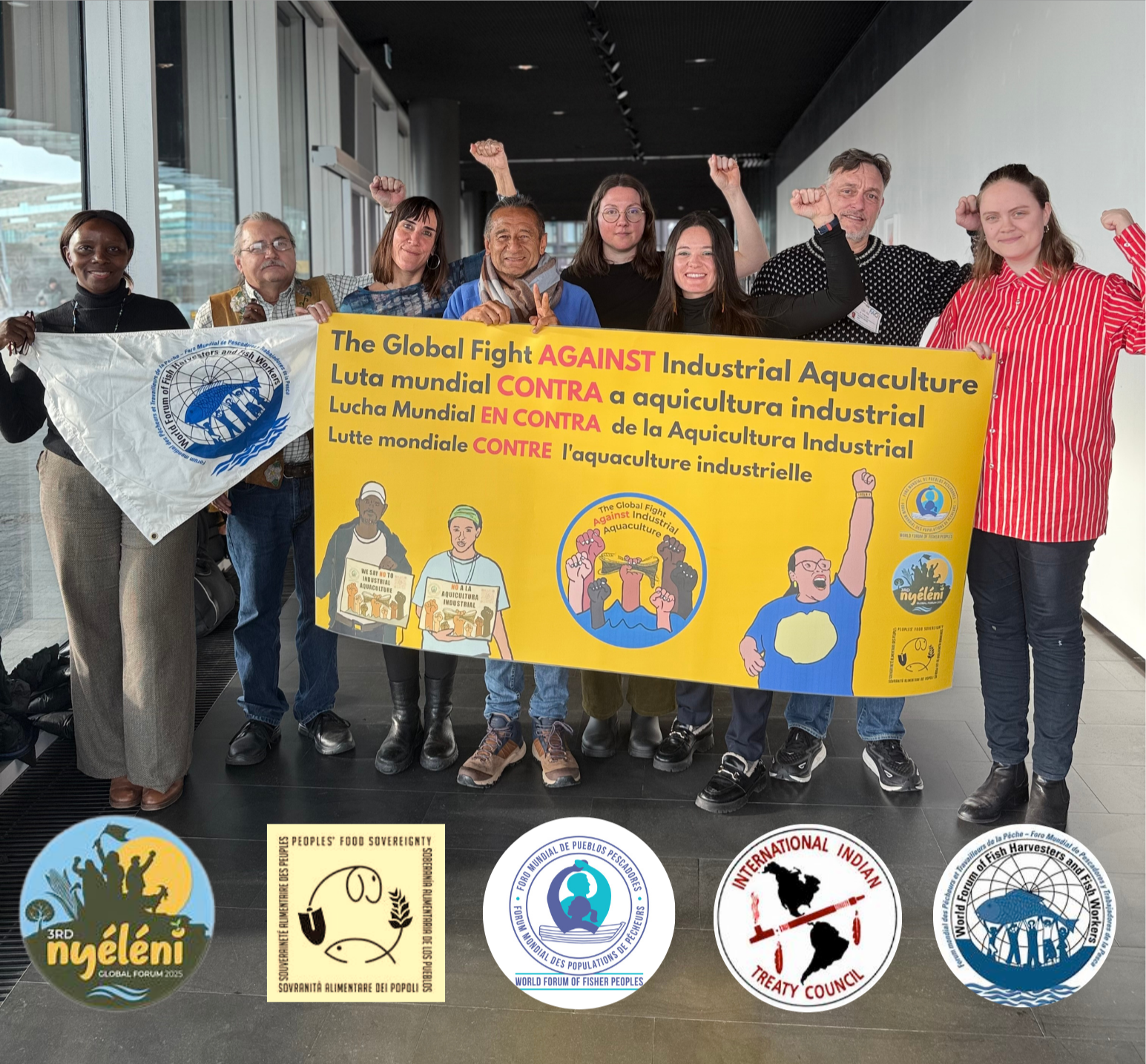
Reykjavik, Iceland – February 26, 2026. Leaders from global social movements and civil society gathered in Reykjavik during the FAO Committee on Fisheries (COFI) Sub-Committee on Fisheries Management meeting, held from February 23–27, 2026, to challenge the rapid expansion of industrial aquaculture and its impacts on ecosystems, food systems, and small-scale fishing communities worldwide.
The press conference was held in the same building where governments are meeting to discuss global fisheries policy, bringing together representatives from the World Forum of Fisher Peoples (WFFP), the World Forum of Fish Harvesters and Fish Workers (WFF), the International Indian Treaty Council (IITC), La Vía Campesina, and other organizations participating through the International Planning Committee for Food Sovereignty (IPC).
Participants warned that governments and industry actors are aggressively promoting industrial aquaculture as a solution to global food insecurity and the climate crisis. However, speakers emphasized that the industry is already causing severe environmental destruction and threatening the livelihoods of small-scale fishing communities worldwide.
Feeding Global Markets, Not Local Communities
Speakers highlighted how the industry prioritizes exports rather than local food systems.
“In countries like Ecuador, Thailand, Honduras, and Bangladesh, 94 percent of aquaculture production goes to international markets, leaving only a small fraction for local consumption,” said Líder Góngora, a fisher leader from Ecuador and member of the World Forum of Fisher Peoples.
“We are using fish that are nutritious and healthy for our people to feed farmed fish and shrimp that are locked in ponds and exported abroad.”
Speakers also emphasized that industrial aquaculture depends heavily on wild fish stocks. Large quantities of wild fish are processed into fishmeal and fish oil used to feed farmed fish and shrimp.
“In many cases it takes five to six kilograms of wild fish to produce one kilogram of fishmeal,”Góngora added, pointing to the ecological contradictions behind claims that aquaculture can solve food insecurity.
Environmental Damage and Community Displacement
Movement leaders stressed that the expansion of industrial aquaculture is already producing severe environmental and social consequences across multiple regions.
From Latin America to Africa and Asia, the rapid expansion of fish farms has polluted waterways, degraded ecosystems, and displaced traditional fishing communities from their territories.
Margaret Nakato, of the Katosi Women Development Trust in Uganda, speaking on behalf of the World Forum of Fish Harvesters and Fish Workers, highlighted the impacts already unfolding around Lake Victoria.
“The expansion of aquaculture in the Lake Victoria region is increasingly restricting fishing communities’ access to fishing grounds and fueling conflicts between small-scale fishers and private companies,” she said.
Nakato warned that aquaculture policies promoted under the “blue economy” framework are displacing fishing communities while serving export markets rather than local food needs.
“The farmed fish does not feed the fishing communities where it is produced. It is exported to countries that are already food secure.”
Indigenous Leaders Raise Concerns for Wild Salmon
Indigenous leaders also raised concerns about the impacts of aquaculture on wild salmon and traditional food systems.
Chief Gary Harrison, of the Water Clan from Chickaloon, Alaska, representing the International Indian Treaty Council, warned that industrial aquaculture threatens the ecosystems that sustain Indigenous cultures.
“The Indigenous people of Alaska are very worried about aquaculture,”
“The places where most wild salmon are now are in our lands and territories. These fish go out to sea and come back.”
He explained that intensive aquaculture creates conditions that promote disease and pollution.
“When salmon are confined and farmed, they become diseased very easily. That’s why large aquaculture operations use antibiotics, which are not good for the environment or for the other species around them.”
Chief Garry also warned that Indigenous communities are increasingly losing access to their traditional fishing grounds.
“Many of the places where Indigenous people used to fish are now taken over by non-Indigenous interests. In many areas we are no longer allowed to fish where we have fished for generations.”
Iceland Faces the Same Threat
Local Icelandic organizations joined the global coalition to warn that Iceland is now facing similar risks.
Þorgarður María Þorfinnandóttir, chairperson of the Icelandic conservation organization Landvernd, said new legislation and expansion plans for salmon farming threaten Iceland’s fragile fjord ecosystems and wild Atlantic salmon populations.
“Aquaculture is not sustainable food production,” she said. “Open-net pens pollute our fjords with organic waste, pesticides, and parasites, while farmed fish escape and interbreed with wild salmon.”
She noted that public opposition to the industry is growing across Iceland.
“Sixty percent of people in Iceland feel negatively about this industry, and the majority want to ban it altogether.”
Þorgarður noted that the industry has gained significant influence over policy debates in Iceland despite growing public opposition.
“It is unbelievable how much influence this industry has on policymakers. Again and again, rules are bent for these companies while our institutions hesitate to stand up for nature and future generations.”
She emphasized that Iceland still has an opportunity to avoid repeating the environmental damage already experienced in other countries where industrial aquaculture has expanded.
“We still have time to make sure we do not give away our pristine fjords to this industry,” she said. “The Icelandic conservation movement is strong and ready to defend nature, wild salmon, and the ecosystems these operations threaten.”
Defending Small-Scale Fisheries
The action in Reykjavik forms part of a broader global campaign against industrial aquaculture led by social movements through the International Planning Committee for Food Sovereignty.
Movement leaders argue that the rapid expansion of industrial aquaculture threatens the implementation of the FAO Small-Scale Fisheries Guidelines, a landmark international framework adopted in 2014 to protect the rights and livelihoods of small-scale fishing communities.
“World fishers demand change. These private interests are invested in a future where small-scale fisheries don’t exist,” said Herman Kumara, General Secretary of the World Forum of Fisher Peoples.
“If we don’t stop this now, resources will go to the pockets of industrial aquaculture instead of supporting sovereign food systems and the communities who actually feed the world.”
Social movements say they will continue organizing globally to defend fishing communities, food sovereignty, and healthy marine ecosystems.
“Aquaculture is not the solution. Securing small-scale fisheries are.”