
As the sun rises over the historic city of Cartagena, Colombia, on February 24, 2026, the Second International Conference on Agrarian Reform and Rural Development (ICARRD+20) officially commences. This landmark event, hosted by the Government of Colombia in partnership with the Food and Agriculture Organization (FAO) and supported by Brazil, marks a pivotal moment in the global struggle for equitable land governance, rural development, and food sovereignty. Building on the legacy of the original ICARRD held in Porto Alegre, Brazil, in 2006, ICARRD+20 brings together over 1,500 participants from more than 100 countries, including government representatives, international organizations, academics, and grassroots leaders. The conference aims to address pressing challenges such as land inequality, climate change, and the dispossession of natural resources, with a strong emphasis on social justice for rural communities worldwide.
At the heart of this gathering is the active involvement of fisher peoples from around the world, who are not only participants but key advocates for the rights to land, water, and territories. Artisanal fishers, small-scale fishery workers, and coastal communities face escalating threats from corporate land grabs, environmental degradation, and geopolitical conflicts that undermine their livelihoods and cultural heritage. Representing diverse regions—from the coasts of Africa and Asia to the waters of Latin America and beyond—these groups are uniting under platforms like the International Planning Committee for Food Sovereignty (IPC) to demand recognition of their customary tenure rights and sustainable management of aquatic resources. Their participation underscores the interconnectedness of agrarian reform with fisheries governance, highlighting how access to water bodies is essential for food security, biodiversity conservation, and combating hunger.
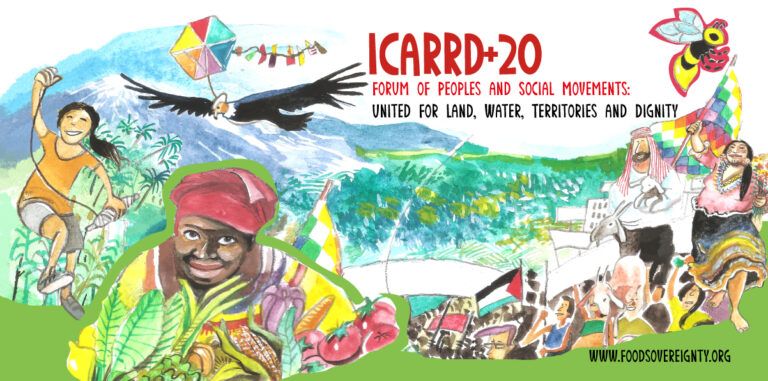
Fisher peoples’ engagement began even before the official start of ICARRD+20, with the Peoples and Social Movements Forum: “United for Land, Water, Territories, and Dignity” held on February 22-23. This autonomous space, organized by the IPC, drew hundreds of delegates from social movements representing peasants, Indigenous Peoples, pastoralists, and artisanal fishers. In a powerful opening “mistica”—a symbolic ceremony—participants reaffirmed that territories are not commodities but sacred spaces for life and sustenance. Here, fisher representatives shared stories of resilience, from defending marine ecosystems against industrial overfishing to advocating for inclusive policies that protect small-scale fisheries amid the climate crisis. This forum served as a vital prelude, allowing these voices to coalesce and prepare concrete proposals for the main conference, where they will contribute to plenary sessions and official panels.
Central to the fisher peoples’ mobilization is the World Forum of Fisher Peoples (WFFP), a global network dedicated to advancing the rights and dignity of small-scale and Indigenous fishers. As a founding member of the IPC’s Fisheries Working Group (IPCFWG), WFFP plays a leading role in ICARRD+20, emphasizing the need for agrarian reforms that extend to aquatic territories. WFFP leaders are at the forefront, calling for the effective implementation of the Voluntary Guidelines on the Responsible Governance of Tenure of Land, Fisheries, and Forests (VGGT), which recognize the unique tenure systems of fisher communities.
WFFP’s emphasis at the summit aligns with broader calls for a “Popular Agrarian Reform NOW,” integrating fisheries into the fight against land dispossession and environmental injustice. By amplifying the voices of marginalized fisher communities, WFFP ensures that ICARRD+20 does not overlook the blue commons—the oceans, rivers, and lakes that sustain billions. Their advocacy draws on decades of grassroots organizing, from policy influence at the UN level to on-the-ground solidarity with affected communities.
As ICARRD+20 unfolds over the next few days, the contributions of fisher peoples, led by organizations like WFFP, promise to shape a renewed global agenda. This summit is more than a conference; it’s a beacon of hope for rural and coastal communities striving for dignity, sustainability, and justice. Stay tuned to the WFFP website for updates, as our delegates continue to champion the cause of fisher peoples worldwide.
Together, we affirm : Territories for life, not for profit!