
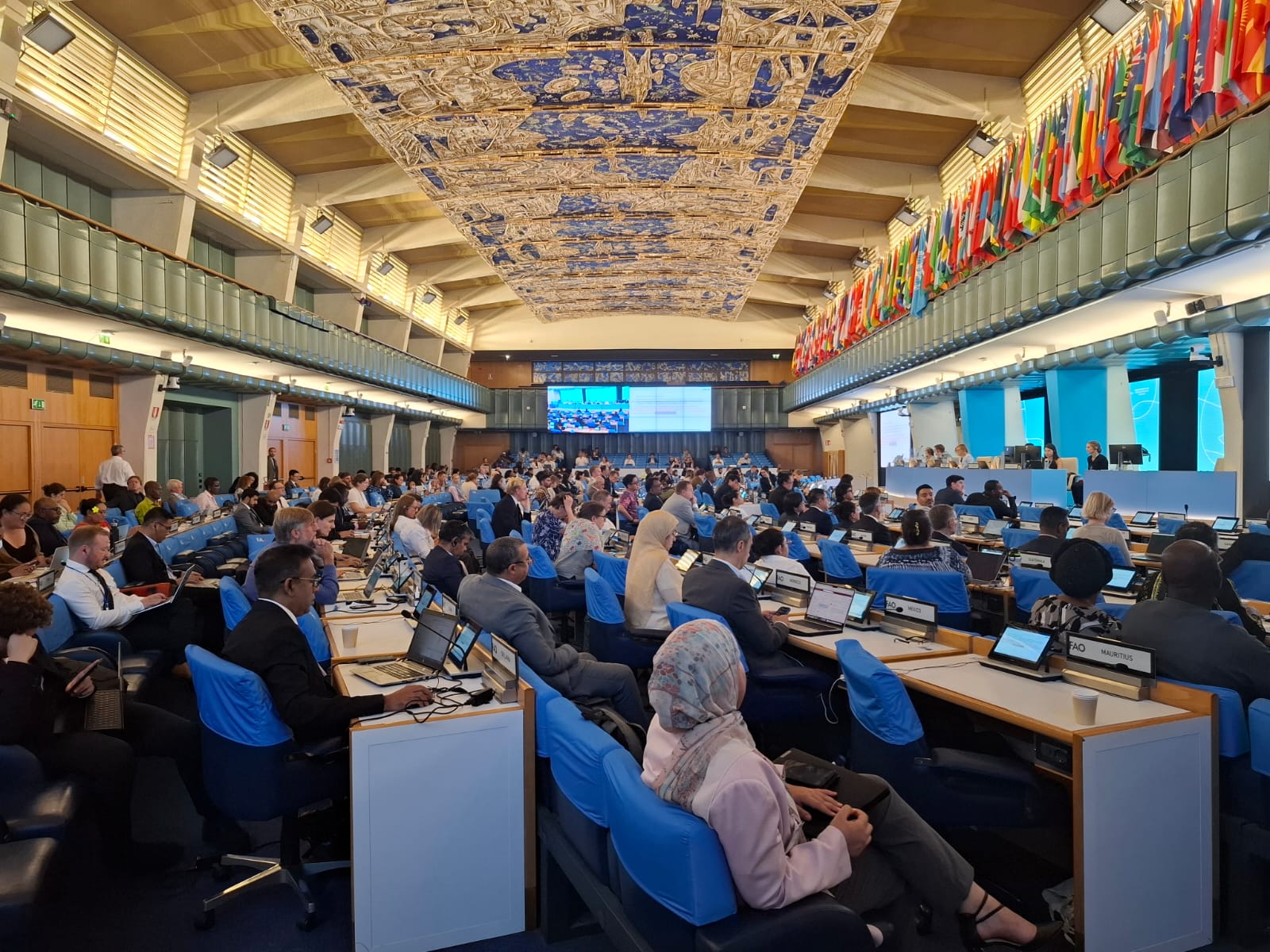
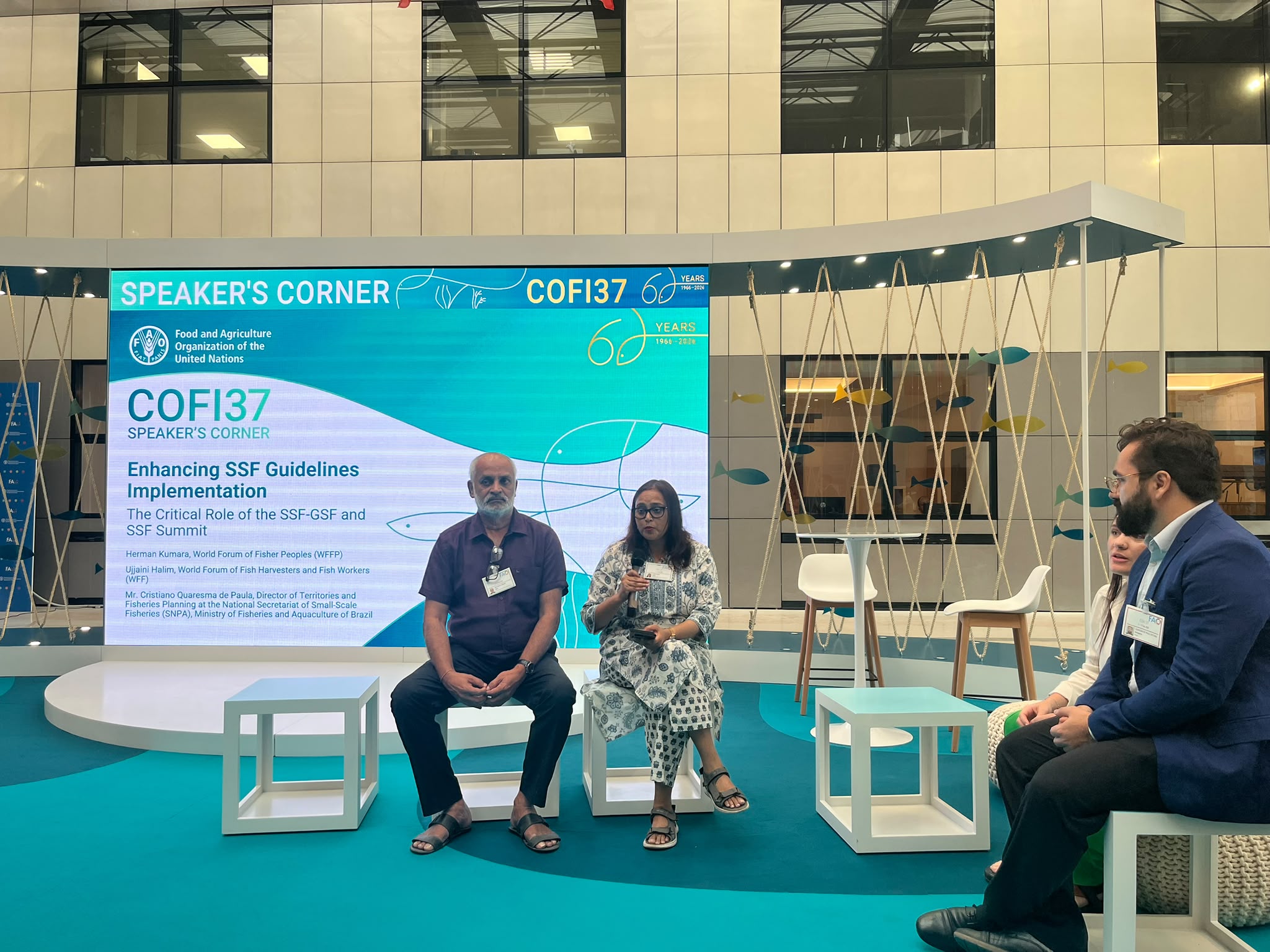
Rome, 7–11 September 2026
While governments debate the future of the world’s fish at the Food and Agriculture Organization of the United Nations, the people who actually live from the water have taken their place in the same halls. This week the World Forum of Fisher Peoples (WFFP) is in Rome for the 37th Session of the Committee on Fisheries (COFI 37). WFFP’s General Secretary, Mr Herman Kumara of Sri Lanka is among the movement’s representatives with Co – Chair Daouda Ndiyaye.
COFI is the only global intergovernmental body where FAO member states meet to set policy on fisheries and aquaculture. The 37th session opened on 7 September at FAO Headquarters and runs through 11 September in hybrid format. Delegates are examining the new State of World Fisheries and Aquaculture (SOFIA 2026) report, progress against illegal, unreported and unregulated (IUU) fishing, climate adaptation, the role of regional fishery bodies, and of particular importance to WFFP’s support for small-scale and inland fisheries.
From the SSF Summit into the Committee
WFFP’s week in Rome did not begin with the formal opening of COFI. From 4 to 6 September, immediately before the Committee, FAO hosted the third Small-Scale Fisheries Summit. That gathering brought together fishing communities, Indigenous Peoples, governments and civil society to take stock of the Voluntary Guidelines for Securing Sustainable Small-Scale Fisheries (the SSF Guidelines) and of National Plans of Action that put those Guidelines into practice. The Summit was designed to support COFI 37.
WFFP takes part in these spaces as a mass movement of more than 10 million small-scale fishers and fishworkers in some 50 countries, and as a member of the International Planning Committee for Food Sovereignty (IPC) Fisheries Working Group, together with the World Forum of Fish Harvesters and Fish Workers (WFF), La Via Campesina and the International Indian Treaty Council. That alliance has for years insisted that small-scale fisheries must remain a stand alone item on the COFI agenda, not a side note in a sub committee. At COFI 36 in 2024 the movement warned that SSF had been pushed off the main agenda. At COFI 37, Agenda Item 9 explicitly addresses “Supporting small scale fisheries and aquaculture, including inland fisheries, and elevating their contributions to food security, nutrition and livelihood support.” That is a result of persistent advocacy.
What WFFP is putting on the table
General Secreatary Mr Herman Kumara’s participation, and that of the wider WFFP and IPC delegation, rests on a clear political line that the movement has repeated from its General Assemblies to the Human Rights Council and now to COFI.
Implementing the SSF Guidelines as rights, not as a brochure. The Guidelines, endorsed by COFI in 2014, recognise customary tenure, the role of women, decent work, and the right of fishing communities to take part in decisions that affect their territories. Twelve years on, WFFP argues that too many states still treat them as optional. The movement calls for National Plans of Action developed with fisher organisations, not merely about them, and for particular attention to inland fishers, who are often invisible in marine-focused debates.
Rejecting ocean grabbing and “false blue solutions.” In its 2026 declaration “We are the Oceans, We are the Waters, We are the Peoples,” WFFP names industrial fishing, coastal reclamation, ports, offshore energy, carbon and biodiversity offset schemes such as 30×30, and corporate aquaculture as drivers that push communities off their waters. The movement treats slogans of “blue growth,” “blue economy” and “Blue Transformation” with suspicion when they open the door to privatisation and financialisation of the sea. WFFP does, however, recognise FAO, COFI, the Committee on World Food Security and the UN Human Rights Council as legitimate multilateral forums in which fisher peoples will continue to fight.
Climate justice from the coast, not only from the conference room. Fishing communities already live with erosion, storm surge, shifting stocks and longer, more dangerous trips. WFFP’s case studies from Senegal’s Petite Côte and Langue de Barbarie to mangrove villages in Thailand document falling catches and the pressure that drives young people into unsafe migration. Adaptation, the movement says, must protect tenure and local knowledge, not relocate communities to make room for conservation or industry.
Women, youth and Indigenous Peoples are not a side event. WFFP’s women and youth caucuses, and its Indigenous Peoples’ assembly, are part of how the movement prepares for Rome. Side events at COFI 37 on women’s leadership in the so called blue economy are useful only if they do not substitute for power in the plenary and in national law.
Keeping fisheries policy in democratic UN bodies. WFFP has long argued that subsidy rules and ocean governance should not be written primarily in the WTO or in closed “ocean conferences” dominated by corporations and large conservation NGOs. COFI, in its view, remains the proper house for those debates provided small scale fishers are in the room as rights holders, not as a photo opportunity.
Why this week matters
Globally, small scale fisheries still account for a large share of employment in capture fisheries and a vital share of local nutrition, especially in the Global South. FAO’s own work on “hidden harvests” has shown how much of that contribution is under counted. At the same time, industrial fleets, coastal development and climate disruption squeeze the same communities. COFI 37 is one of the few places where those two facts can be placed, officially, in front of the governments that regulate both.
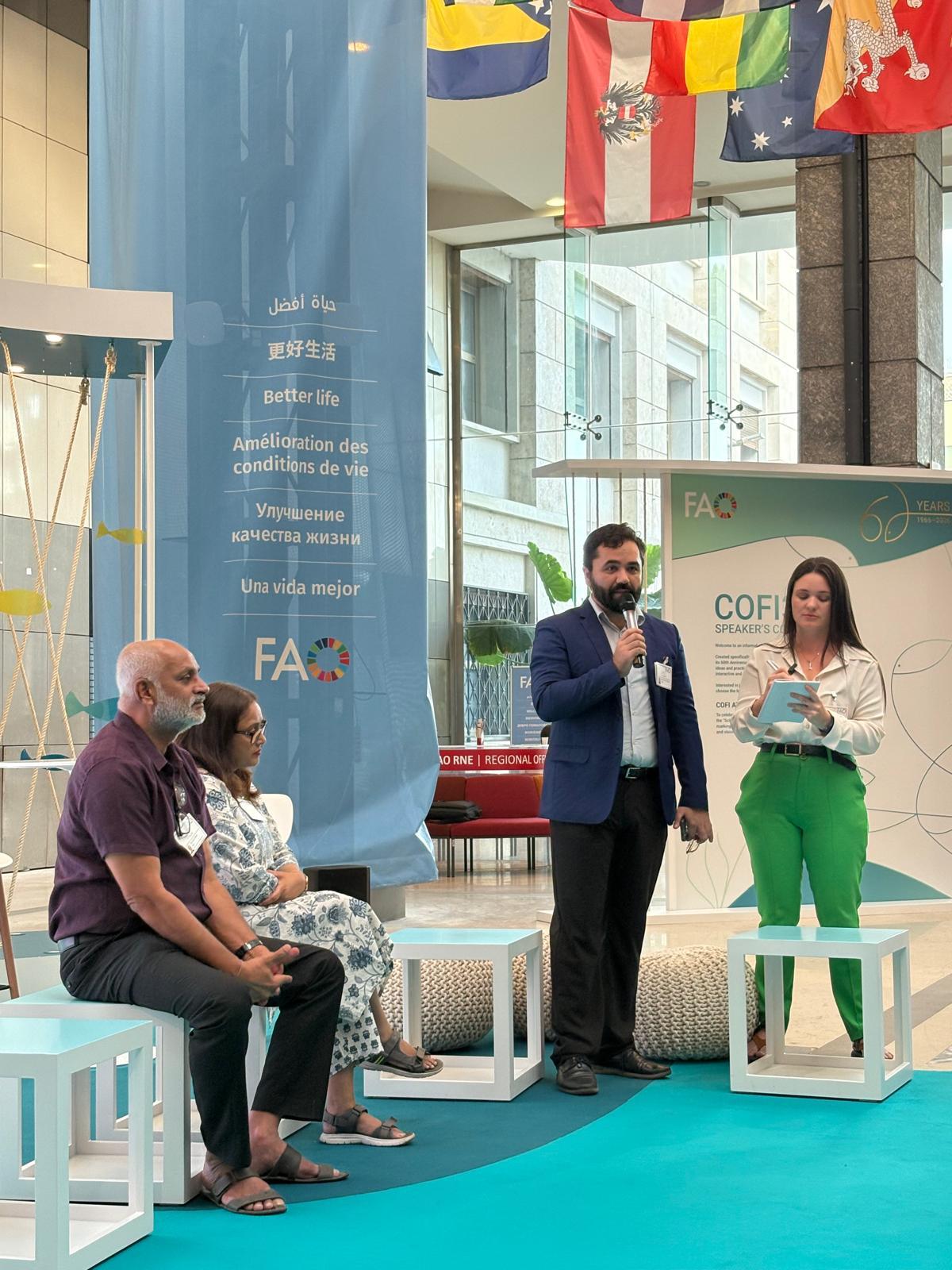
WFFP’s message from Rome is consistent with the line General Secreatary Mr Herman Kumara has carried through previous assemblies: “Nothing about us without us.” The video of the General Secretary at the forum is not a souvenir. It is evidence that fisher peoples intend to stay inside the institutions that write the rules of the sea and to keep those rules from being written over their territories. The Committee’s report will be adopted at the close of the session. What will matter after the delegates leave Rome is whether national plans of action, tenure security, and real participation follow or whether the speeches remain in the archive while the grabbing continues on the coast.